
Inside the Manosphere I: The Media Spectacle is a Distraction
Louis Theroux’s "polite interrogation" of a digital freak show is less excavation than media reflex. It’s time we stop gawking at the influencers and start dismantling the machinery.
From the romanticizing of Middle Eastern uprisings to the fetishizing of Kurdish women fighters, I am tired of spectacle-driven media takes that flatten lived realities, ignore structural power, and mistake performance for insight.

New here? This essay is part of The Safari Is Over: Why Louis Theroux Never Made It Inside the Manosphere, a series on the systems and incentives that have made the manosphere more visible, more influential, and more misunderstood. Read the series introduction and announcement here. Follow and subscribe on Substack.
When Louis Theroux’sInside the Manosphere1 landed on Netflix last month, it seemed to promise a public service. At last, here was a mainstream documentary promising to enter an ecosystem that has spent years radicalizing grievance, laundering misogyny as self-help, and turning humiliation into a business model.
But the film mistakes so-called access for understanding.
Theroux is the undisputed master of the faux-naïve encounter: the blinking, bumbling Englishman whose disarming politeness usually coaxes the truth out of fanatics. For years, that method worked because exposure still carried moral weight. To be seen clearly—saying vile things aloud, revealing dehumanizing beliefs, and performing your own moral squalor for the camera—was, in itself, compromising.
But in the neon-lit gyms and high-rise apartments of the so-called “manosphere”2, his act feels less like a method than a valuable asset inside a content machine run by a motley crew of savvy hustlers and manfluencers3. Rather than a rigorous inquiry into the system that makes the manosphere profitable, reproducible, politically useful, and dangerous, the documentary plays out as a digital safari.
Across its 91-minute runtime, Theroux gawks at hyper-masculine grifters and flamboyant villains, offering viewers a guided tour through the spectacle while obscuring the machinery, incentives, and deeper actors sustaining it.
But who can really blame him?
In one scene, we watch as 24-year-old British TikTok influencer HS TikkyTokky, née Harrison Sullivan, casually presents his phone to show Louis a video of himself receiving oral sex in a club toilet just hours earlier.
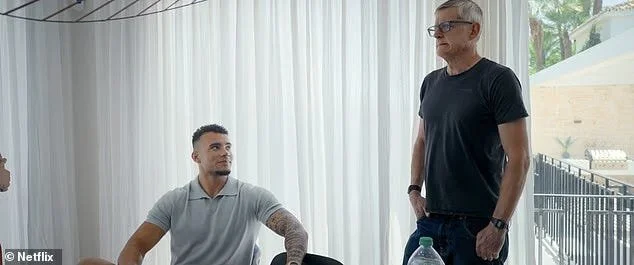
Sullivan, right, appears amused and almost triumphant after showing Theroux the graphic video, bragging that he had been “out late getting content.” Source: Netflix
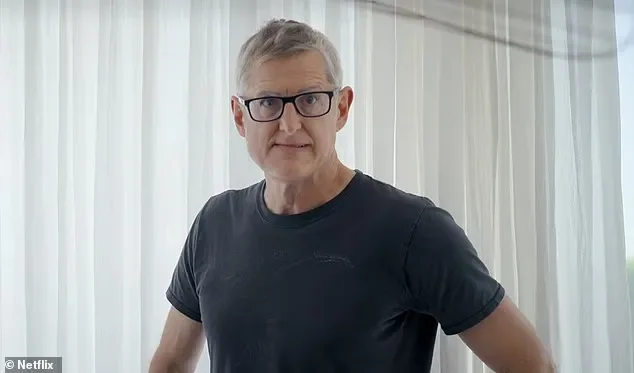
Theroux appears visibly disgusted. Source: Netflix
We see the Fresh & Fit podcast studio functioning like a digital-age Roman coliseum, where Myron Gaines and his co-host invite young, unprepared women onto the podcast only to badger and degrade them before a live audience of thousands.
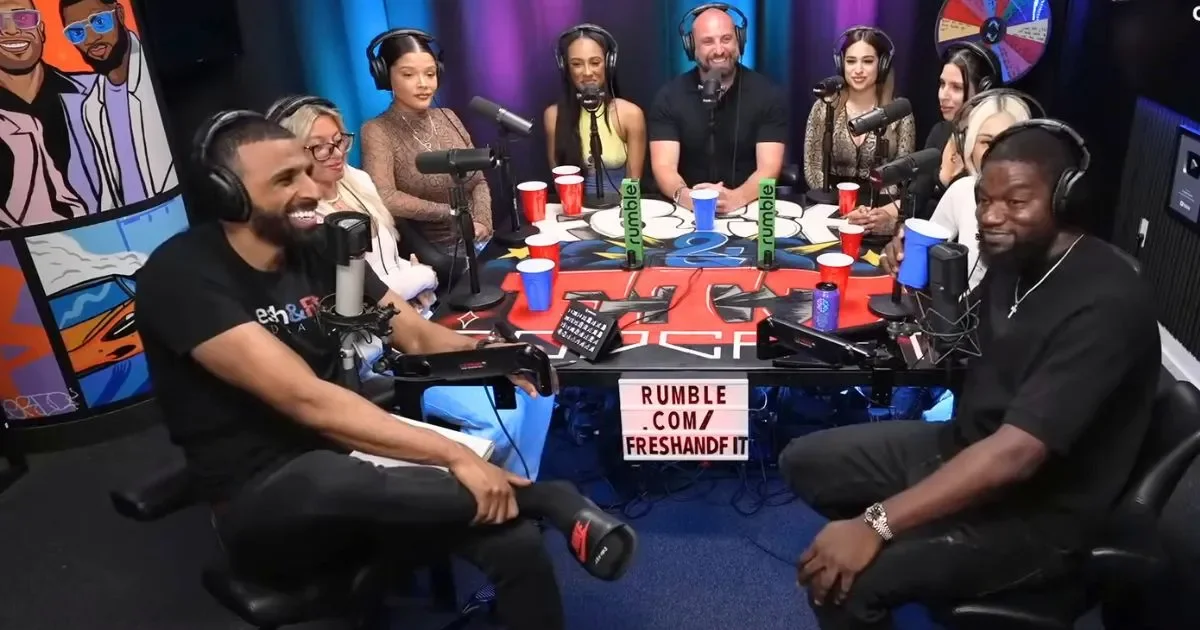
Even Theroux, long practiced in meeting extremists and fanatics, appears visibly astonished by the sheer spectacle of it all.
And that is precisely the problem. The manosphere is not just a collection of obnoxious men with ring lights and microphones, nor merely a niche internet pathology. It is a networked commercial ecosystem built on grievance, gender panic, extremist ideology, and algorithmic escalation. It monetizes male insecurity, packages domination as clarity, and converts resentment into recurring revenue.
That is where the documentary goes wrong. By treating the manosphere mainly as personality, or as “toxic masculinity” embodied by a young, amoral generation, it mistakes spectacle for explanation. More broadly, it reflects a recurring failure in mainstream media: when coverage locks onto the face, the clip, and the performance, structure recedes behind character. Systemic critique collapses into character study.
Theroux leans into that logic. He centers the individual as both narrative engine and easy-to-digest villain, while sparing Netflix and other platforms a more unpleasant analysis of the algorithmic incentives and systemic forces that built these men in the first place.
More importantly, he misses a crucial point: these men are not simply being themselves. They are performing profitable characters for a global audience. If Theroux had set up the conditions to break the façade, or brought in someone with deeper knowledge of the space, a more revealing truth about both these figures and the ecosystem they inhabit might have emerged.
Instead, he falls into a profound irony. In trying to expose the spectacle, he reproduces its logic, prioritizing performance over systemic accountability. He gives a global stage to the movement’s preferred symbols of success— supercars, crypto wealth, and the livestreamed objectification of women— while looking past the wreckage and the invisible majority left in their wake.
The deeper question is not simply what these men do, but what kind of system rewards this behavior in the first place.
The manosphere does not run on conviction alone. To stay solvent in the attention economy, red-pill influencers have learned to commodify misogyny and spectacle, paying a kind of mandatory tax of the macabre to remain visible.
They engage in clip-farming and context stripping, distilling hate into its most viral form for algorithms that reward the most jagged edges of the human psyche. Under incentives that reward outrage, humiliation, and extremity, they monetize the demolition of their own dignity4, knowing that only the most visceral provocations reliably break through the noise5.
Research points to precisely this logic: repeated exposure, recommendation loops, normalization, and monetized escalation. Seen through that lens, many of the documentary’s most infamous moments look different. They are not just signs of moral rot. They are also signs of market discipline.
What looks like shamelessness is often evidence that private life has been fully absorbed into production. Sex, shame, cruelty, confrontation, humiliation—nothing remains outside the feed if it can be monetized within it. Yet the documentary returns to these scenes as if their extremity were the deepest thing about them. It is not.
The deeper fact is that this ecosystem now requires escalation. In a saturated market of outrage, neutrality is death, moderation is invisibility, and dignity does not scale. The men in this space are not only rewarded for transgression; many are trapped by the need to intensify it. That would have been the documentary’s real subject, had it trusted the harder story.
And once you see that escalation is not incidental but structural, the ecosystem begins to look less like chaos than hierarchy and ideological convergence.
At the top sit the better-insulated operators: figures like the Andrew Tates, with diversified revenue, political adjacency, private channels, event circuits, loyal fan economies, and off-platform leverage.
Beneath them is a much larger class of clippers, podcasters, streamers, outrage merchants, and masculinity entrepreneurs who depend almost entirely on algorithmic visibility. They posture as sovereign men while living in profound dependence on Big Tech and the upper tiers of manosphere hierarchy.
This hidden hierarchy matters because it makes the ecosystem legible. It shows who is protected and who is disposable. It explains why “community” so often turns out to be a marketing fiction rather than brotherhood or connection.
It also reveals that many of the loudest figures, like those featured in the documentary, are not architects so much as products: profitable, vicious, disposable, replaceable.
The hierarchy also reproduces itself through recruitment. More established operators do not simply build audiences; they court younger influencers, pull them into their orbit, and turn them into feeder figures for the brand. The point is not just ideological alignment. It is audience capture.
Sneako illustrates the pattern. He first built an audience as a teenage YouTube creator long before entering the manosphere, then was drawn into Andrew Tate’s orbit and recast as a younger, more platform-native extension of that world, quickly earning a reputation as Tate’s protégé.6
His more recent fallout with Tate reveals the fragility of loyalty in the red-pill economy. What looks like mentorship is often a form of capture: the absorption of new faces, new markets, and new streams of grievance into the machine. In a hierarchy built on clout, access, and followers, conflict is never merely personal. It is also a struggle over succession—over who gets to inherit the brand, the audience, and the authority of the “Top G.”
In that sense, the manosphere can begin to resemble a minor geopolitics of influence: alliances are tactical, loyalty is conditional, and succession battles are fought through audiences as much as ideology.
In a recent video, Sneako put it this way:
“The Matrix sees slop and clout, and they love you. They give you everything […] But once you speak to people that are different than you—that is when the vultures come out of nowhere and swarm.”
That hierarchy, and the recruitment funnel it depends on, also help explain who benefits from keeping the system volatile. The manosphere does not exist in isolation. It is embedded in a wider ecosystem of actors who derive value from that volatility: ideologues, extremists, and power brokers whose reach extends far beyond fitness tips and lurid scenes.
Researchers increasingly describe the manosphere as a networked ecosystem in which misogynistic narratives circulate across overlapping subcultures, often intersecting with other forms of extremism and moving beyond the niche digital margins they once appeared to occupy.
Experts have also repeatedly pointed to overlaps with far-right ecosystems, including white supremacist and anti-democratic currents. Some recent counter-extremism research suggests that today’s radicalization landscape no longer fits neatly into clean ideological boxes. What investigators increasingly encounter instead are blurred, unstable, and overlapping formations.
That ambiguity is part of the danger. It makes these ecosystems harder to track and harder to counter precisely because grievance, entertainment, influencer culture, and ideological radicalization now bleed into one another.
Those overlaps are no longer peripheral. Figures like Sneako and Nick Fuentes help show how misogynistic branding, far-right politics, antisemitism, and celebrity spectacle increasingly merge and spill into one another.
A recent viral clip of Andrew and Tristan Tate, Nick Fuentes, Sneako, and others partying in a Miami nightclub while Kanye West’s “Heil Hitler” played in the background is a crude but telling example of that convergence: misogynist influencer culture, far-right provocation, celebrity antisemitism, and platformed spectacle collapsing into the same scene.
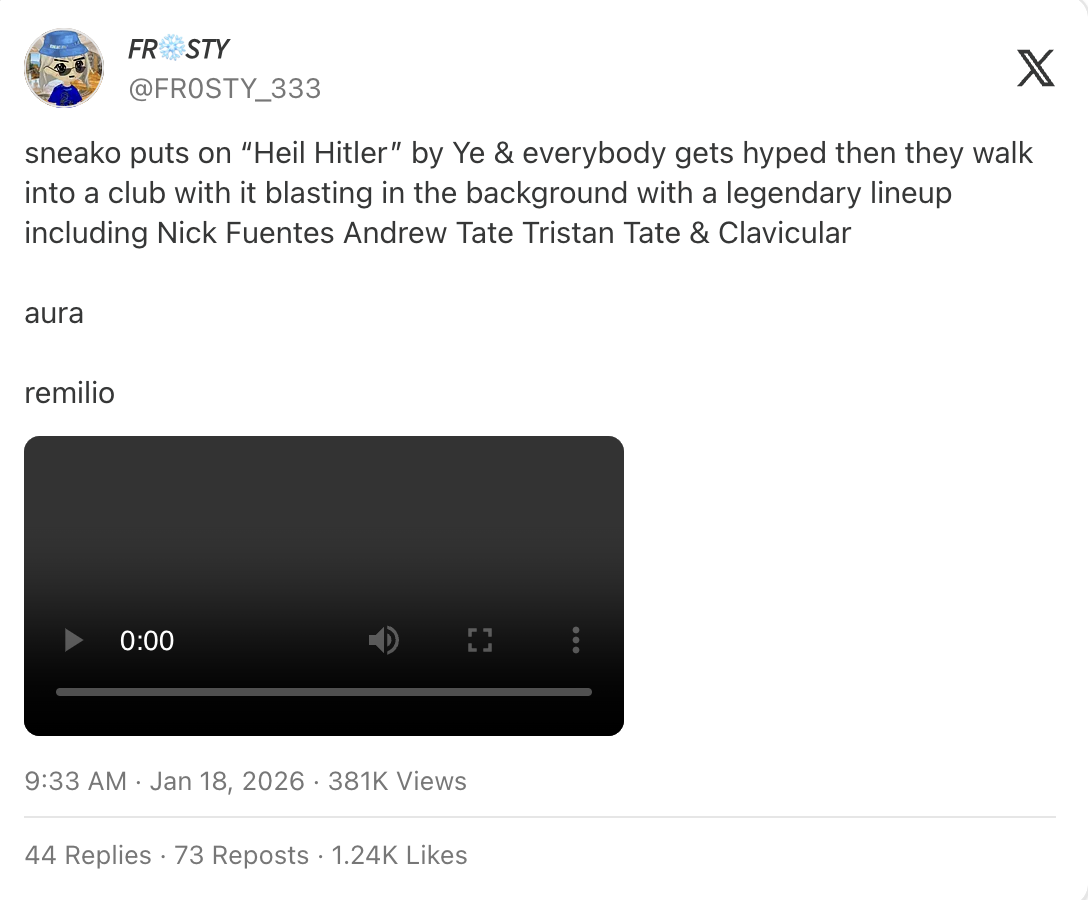
Original Link on X
By chasing visible manosphere figures without following these ideological mergers to their outer edges, Theroux misses the deeper and more dangerous intersections with actors like Nick Fuentes, who use alpha rhetoric and gender grievance as Trojan horses for broader radicalization and incitement.
That is why the documentary, for all its so-called access, never really gets “inside” the manosphere.
Instead, it raises a critical ethical question: does the film function as a critique, or merely as a larger stage for the reciprocal grift?
By prioritizing shocking, performative moments over structural analysis, the documentary leans into spectacle journalism, where the line between interrogation and amplification becomes dangerously thin, creating a parasitic symbiosis in which legacy media and the renegade manosphere perform for one another, each using the other’s platform to reinforce its own relevance, visibility, and clout. It exposes the banality of the scam behind the curated personas, yet remains entangled in the same attention economy that sustains them.
For all its bile and spectacle, the most striking thing about the documentary is how “meh” it feels. Packaged as awareness, its rhetoric is often barely distinguishable from the sensationalist content and extremist provocations already circulating through news cycles, political discourse, official rhetoric, and algorithm feeds.
If anything, the film feels tame because we are already trapped in a feedback loop where the bar for outrage keeps rising and the machinery of radicalization has become ordinary.
This is not a fringe problem, and it is not far from home. Research suggests that manosphere content now forms part of the online environment many people, including young users, can encounter directly. Related UK data also show that 19 percent of those arrested for terrorism-related offenses in 2023 were aged 17 and under.
That does not mean every misogynistic influencer space is a terrorism pipeline. It does mean the wider ecology of radicalization, grievance, and digitally mediated harm can no longer be treated as niche.
Not when so many young users encounter fragments of it directly and daily.
Not when its styles and logics have already leaked so thoroughly into public discourse.
Not when the bar for outrage has been pushed so high that degradation now reads as ordinary content.
And the effects of spectacle journalism and media storytelling are not incidental. They are corrosive.
On audiences, it heightens attention and emotional arousal while often eroding credibility, especially in hard news7. Over time, it breeds fatigue, cynicism, avoidance, and a public that is overstimulated but underinformed.
For journalism, it shifts incentives from verification and depth to visibility, personalization, and performance.
For public discourse, it favors scandal, conflict, and personality over policy, process, and structure.
For democracy, the problem is not simply vulgarity. It is that spectacle weakens the conditions democratic judgment requires: trust, shared factuality, deliberative attention, and sustained engagement with public life.
And for the invisible majority8, it turns casualties into background. The people who profit from attention stay at the center of the frame; the people who bear the costs are pushed to its edges.
We are already saturated by an attention economy that trains us to treat humiliation, conflict, and dehumanization as normal. To keep platforming spectacle at the expense of a better-informed public is professional malpractice.
It is time to move beyond spectacle and cynical grift and start examining this as a crisis of connection, accountability, power, and political formation.
The safari is over.
Key takeaways
The manosphere is not a roster of outrageous men. It is a networked commercial ecosystem, and reporting and storytelling should treat it as such.
When coverage centers the performer, it risks mistaking access for understanding and spectacle for explanation.
Extremity is not always revelation. Often it is market discipline: content shaped by platforms, monetization, and the demand for visibility.
The real story is usually off-camera: hierarchy, incentives, audience funnels, ideological overlap, and who profits from amplification.
Spectacle-centered coverage can unintentionally strengthen the system it claims to expose by routing attention, legitimacy, and curiosity back to its most marketable figures.
Good reporting and storytelling should ask not only what was said, but what is being optimized, who is being recruited, what is being normalized, and what has been pushed out of frame.
The people most visible in these ecosystems are not always the most powerful. Many are replaceable performers inside a larger machine.
When coverage keeps the loudest performer at the center, the people harmed by the system become background.
Companion resources
Because this problem extends beyond one documentary or one subculture, this essay is accompanied by additional practical resources, publishing in the upcoming days and weeks:
A guide for journalists and editors on avoiding spectacle, reducing amplification, and reporting the system rather than the performance.
A separate audience tip sheet for readers, parents, educators, and viewers on how to recognize spectacle, pause escalation, and ask better questions about what platforms are rewarding.
Practitioner’s note:We Are Not Your Spectacle A critique for Western Media Practitioners, from Your Arab American Peer.
Note to Readers
This essay is the first in a series, The Safari Is Over: Why Louis Theroux Never Made It Inside the Manosphere. Using the documentary as a starting point, the series examines the wider systems, cultures, and conditions that have made the manosphere more visible and more misunderstood. Read more here.
Media, Research, and Professional Inquiries
For media requests, speaking invitations, consultations, collaboration inquiries, or professional contact, please reach out at inquiries@rajaalthaibani.com or connect via Substack or LinkedIn messenger or via my website contact form.
FOOTNOTES
1 Louis Theroux’s Inside the Manosphere: Louis Theroux, director, Louis Theroux: Inside the Manosphere (Mindhouse Productions/Netflix, 2025), Netflix Official Site.
2 “Growing ultra-masculine network”: Quoted from the official Netflix landing page for Louis Theroux: Inside the Manosphere. See Netflix / Tudum page for the documentary description and release details.
3 The Manosphere refers to a decentralized network of websites, blogs, and forums—including incels, pick-up artists, and Men’s Rights Activists—often characterized by misogyny and opposition to feminism.
4 Manfluencer: A portmanteau of “man” and “influencer” used to describe male social media personalities who weaponize performative ideas of masculinity and promote regressive notions about women.
5 Dignity is a barrier to virality. True human connection is slow and nuanced. By demolishing it—dehumanizing women, mocking "weak" men, or staging cruel pranks—the influencer creates a spectacle of dominance. This satisfies the "Alpha" brand while providing the high-contrast imagery (wealth vs. poverty, strength vs. weakness) that performs best visually on mobile screens.
6 Sneako, née Nico Kenn De Balinthazy, a 27-year-old influencer who first found an audience as a teenage YouTube prodigy long before he became associated with the manosphere. He was initially known for creative editing, Call of Dutyvideos, street-style commentary. In the post-Covid period, and after upheaval in his private life, he was drawn into Andrew Tate’s orbit.
7 Hard news refers to urgent, factual, and significant reports on topics like politics, international affairs, crime, and the economy, designed to inform the public quickly. These stories are time-sensitive, often using the inverted pyramid structure to place crucial facts first. It contrasts with soft news, which is more entertaining or human-interest focused.
8 Nick Fuentes is a prominent far-right live-streamer and leader of the “Groypers,” a loosely organized group of white nationalist and alt-right activists. While primarily known for white supremacist and anti-Semitic ideologies, Fuentes is also a key figure within the extremist, political wing of the “manosphere”. He promotes intense misogyny, arguing that women should be disenfranchised and that their primary role is in the home.